Seeing Ryan
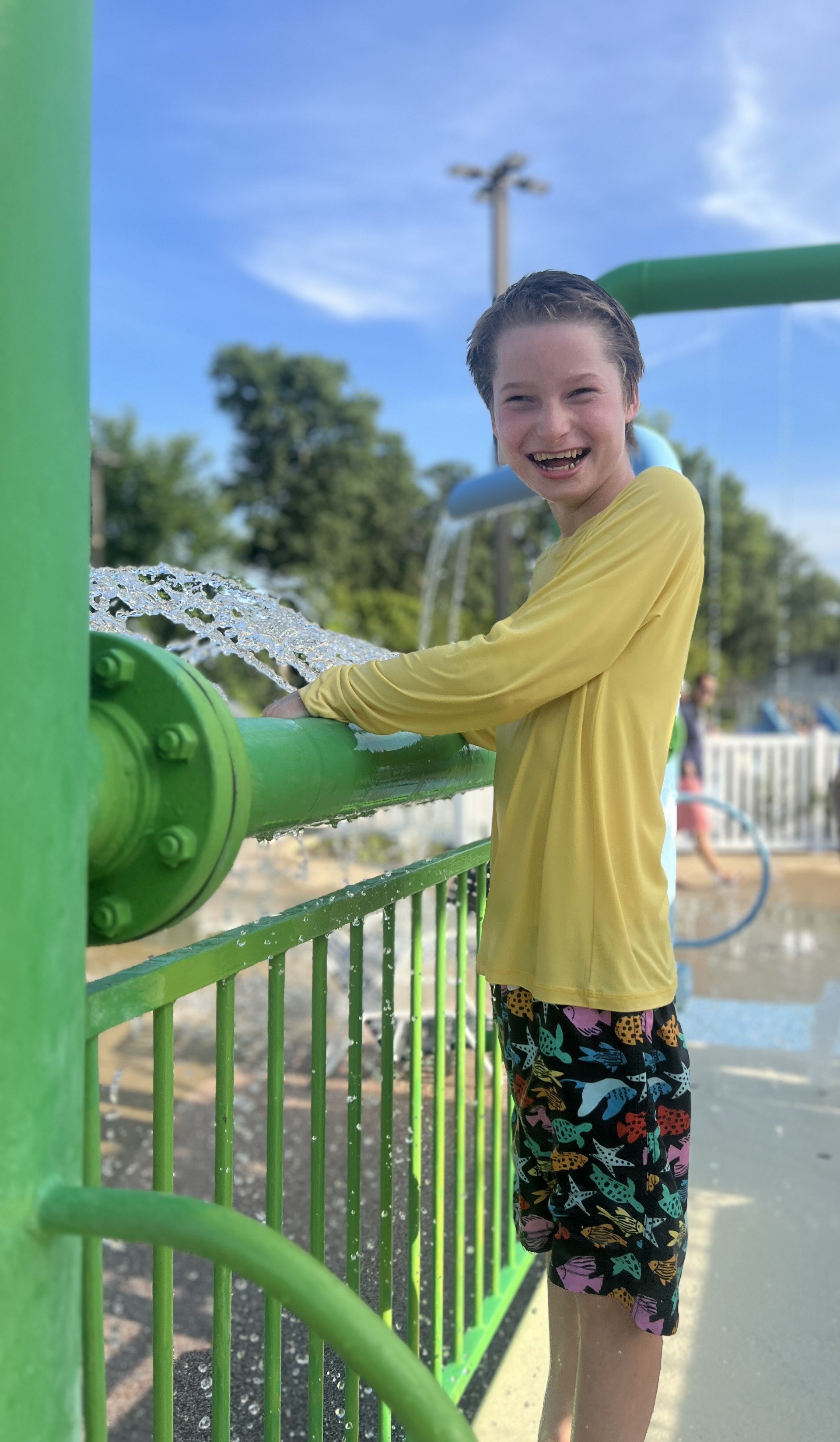
The O’Connor family on joy, exhaustion, progress—and why awareness begins with seeing the boy before the diagnosis
If you want to understand 11-year-old Ryan O’Connor, Angelman syndrome probably isn’t the best place to start. Start with the long burp scene in Elf. It can pull Ryan out of almost any funk. He loves wrestling with his dad, Ben, fart sounds and the sort of humor one would expect from an 11-year-old boy. He loves apples, salads, peppers, music, anything involving water and he loves people. “Ryan is a ball of energy and joy,” says his mom, Elizabeth O’Connor. “His laughter is infectious.” Ryan also cannot communicate through speech. He uses an AAC device, gestures and other forms of nonverbal communication. His family remembers the excitement when he learned to use his pointer finger, giving him another way to indicate what he wanted and make choices for himself. “It may seem like a small thing,” Elizabeth says, “but for Ryan it was a really big deal.”
That is part of what life with Angelman syndrome has taught the O’Connors: progress has its own scale. “We celebrate the smallest steps forward because we know how hard he has worked for them,” Elizabeth says. “Things we might once have taken for granted feel incredibly meaningful now.” But Elizabeth and Ben are equally candid about the other side of that equation. Ryan requires care 24 hours a day. There is unpredictable sleep, constant supervision and a level of vigilance that does not necessarily lessen as he gets older, and ordinary Lake Bluff moments that can make an “extraordinary” reality suddenly difficult to swallow. “When I see other kids Ryan’s age riding their bikes around town by themselves, it can make our reality even harder to digest sometimes.” There is no neat progression in which the diagnosis became steadily easier to accept. “This journey is not linear,” Elizabeth says. “There have been so many peaks and valleys along the way, and I think we have learned to take them as they come.”
Ryan’s younger siblings, Patty, 9, and Jay, 5, know those peaks and valleys too. They understand their brother remarkably well, laugh, recognize what he wants and give him grace when the frustration of not being able to speak becomes too much. Although younger, “they act as Ryan’s older siblings in so many ways,” Elizabeth says. Growing up with Ryan has given them a perspective their parents never could have deliberately taught. “Ryan is normal to them, so having someone close to them with special needs is normal too.” Yet, Elizabeth is careful not to romanticize that experience either. Patty and Jay help with Ryan and carry responsibilities that most children their age don’t. They have already learned to answer friends’ questions about Angelman syndrome and to defend their brother when other children misunderstand him or are unkind. The O’Connors try to hold both truths: their younger children are becoming unusually capable advocates and sometimes they need permission simply to be 9 and 5.
One misconception is particularly difficult for the family—because Ryan doesn’t speak, people can assume he doesn’t understand. “His emotional intelligence is incredibly high,” Elizabeth says. “He can sense when people are uncomfortable or unsure how to interact with him.” Bluffers that are lucky enough to run into Ryan don’t need to know how to use his communication device or know exactly what to say and they definitely don’t need expertise in Angelman syndrome. They can say hello, offer a high five and smile. “Just take a moment to see him.” To Elizabeth, that’s a big part of what raising awareness actually means.
The other part is also incredibly important. A friend Elizabeth met through paddle learned about Ryan, attended one of the family’s fundraisers and became interested in Angelman syndrome. She also happened to be a neuroscientist at Rosalind Franklin University and has since applied for a grant from the Foundation for Angelman Syndrome Therapeutics (FAST) to bring her expertise into Angelman research. “You just never know who is listening or how they might be able to help,” Elizabeth says. That is particularly important in rare disease, where philanthropy can help fund early research, attract scientists to an under-studied condition and move promising ideas forward. FAST was founded by parents unwilling to wait for someone else to solve the problem, which the O’Connors understand well. Whether someone gives $25 or $1,000, Elizabeth says, those individual contributions become part of something larger.
This is where the O’Connors celebrate now what they once would never have thought to celebrate and things other families take for granted that can still hurt to watch. A diagnosis can change what independence and parenting looks like, but it can exist alongside wins that feel bigger, siblings that will walk through life with a little more awareness, and laughter that breaks through moments as beautiful relief. Often in the form of fart noises. “Angelman syndrome is a big part of our lives,” Elizabeth says, “but it is not all of who Ryan is.” Ultimately, that is what she and Ben hope people understand.

Paddle Party for a Purpose — Scan to attend, donate or learn more. Friday, November 20, 6:30–10:30 PM at Exmoor Country Club. Benefiting FAST in honor of Ryan O’Connor.