Playing for Purpose
Leslie Leonardi looks back on more than a decade of wiffle ball, friendly competition and giving back in Lake Bluff
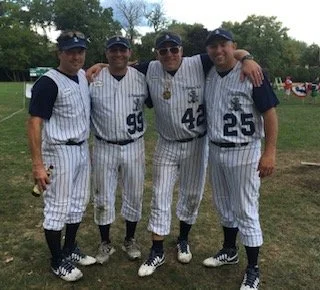
Original founding team: Paul Pezza, Jac Leonardi, Mike Arvia, Brandon Monk.
In 2013, Jac Leonardi and former Bluffer Brandon Monk had an idea: take the model of a charity golf outing and replace the golf with something nearly anyone could play - wiffle ball. The first Lake Bluff Charity Wiffle Ball Classic featured five men’s teams playing on a single field at Artesian Park, with a handful of spectators watching from the sidelines. The following year, two women’s teams joined. By the fourth year, 19 teams had signed up.
Jac’s wife, Leslie Leonardi, remembers thinking at the time that the tournament had become enormous. “I remember being excited when we had 19 teams, thinking that was crazy,” she says. More than a decade later, the Classic hosts 43 teams and has become a fixture on the Lake Bluff calendar - one that Leslie says people have described as their “second favorite day in Lake Bluff after July 4th.”
For all that growth, the premise remains remarkably simple: bring people together to play wiffle ball and raise money for causes that matter to them. That charitable component has also given Leslie some of her most meaningful memories of the tournament. Winning teams choose organizations to receive tournament proceeds, and Leslie says she loves learning the stories behind those choices.
One year, the meaning behind the winning team’s choice was especially close to home. Zach Porter had been a longtime participant in the Classic, playing alongside his high school baseball teammates, a team known as “Orange Juice.” Following Zach’s death at age 20, his family established the Zachary Porter Foundation in his memory.
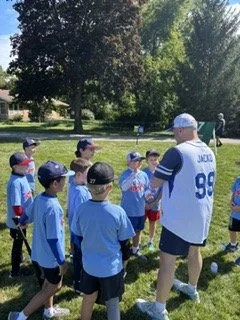
Jac Leonardi with youth team “Lil Rynos” doing paper/rock/scissors to determine the home field
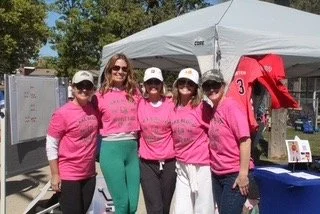
At the tournament, his sisters took the field in his honor and went on to win the women’s division, choosing the foundation to receive their share of the proceeds. The tournament ultimately donated $19,000 to the Zachary Porter Foundation. “I felt that day was a small reminder of what this community can do for each other,” Leslie says.
Sometimes Leslie doesn’t learn what a donation has meant until after the tournament is over. House of Peace in Waukegan, which provides shelter and support to families affected by domestic violence, was another recipient. Leslie later received a note explaining that the Wiffle Ball Classic’s contribution had been enough to fund the entire shelter for 10 nights. “That fills my heart,” Leslie says.
Over the years, the tournament has become its own small production, with as many as 13 fields and backstops in use. The Lake Bluff Park District provides the fields and shelter, while a group of volunteers returns year after year to handle the countless details most participants never have to think about.
Drew Irvin handles the music and Jill Irvin does the design work. Dana and Clint Hansen feed the village, buying and cooking roughly 350 hamburgers and 200 hot dogs. Justin Smith makes the annual T-shirt and Mac Atzeff takes photos of the day. “So many have volunteered through the years to help score keep and keep things moving throughout the day: Anna Thor, Renee Moore, Maggie Chlystek, Ann Rieder, Jen Arvia, Annie Pezza, Catherine Longwoth and so many more,” Leslie says with gratitude. “It’s a labor of love.”
After more than a decade, that may be as much a part of the story as the wiffle ball itself. The tournament has grown because people keep showing up - not only to play, but to cook, keep score, set up fields, play music, lend a hand wherever it is needed and then return to do it all again the following year.
“It’s about people seeing their neighbors in a different light,” Leslie says. “Friendly competition and charity brings out the best in all of us.” For one day, the usual roles around town get shuffled. Parents play while kids watch. Friends compete against friends. People who might ordinarily exchange little more than a wave find themselves standing together and having a drink. Neighbors become teammates or opponents - all showing off wildly creative team names and uniforms. One of them gets bragging rights until next year.