Reasons to Walk. Reasons to Hope
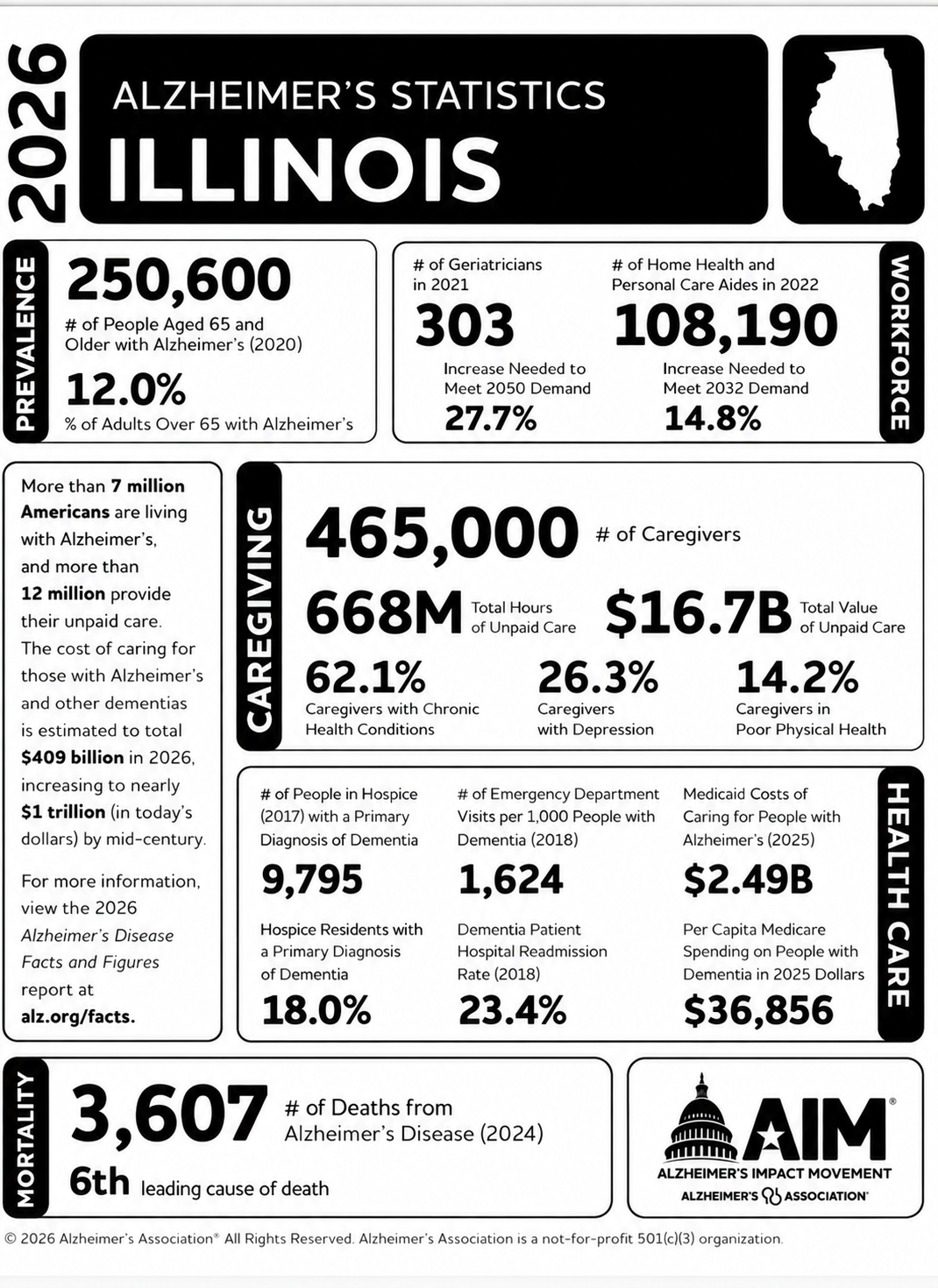
2026 Illinois Alzheimer’s statistics. © 2026 Alzheimer’s Association.
Bluffers have opportunity to join the Lake County Walk to End Alzheimer’s as promising treatments emerge
The numbers behind Alzheimer’s remain daunting but the science behind them is beginning to tell a different story. For families who have lived with Alzheimer’s disease, the numbers can feel almost too large to absorb. An estimated 7.4 million Americans age 65 and older are living with Alzheimer’s dementia in 2026. Here in Illinois, that number is approximately 250,600. More than 465,000 Illinois caregivers provide an estimated 668 million hours of unpaid care—work valued at $16.7 billion. For Lake Bluff resident Lynn Johnson, those statistics are anything but abstract. “Alzheimer’s has touched my family in a deeply personal way,” says Johnson, a volunteer leader for the Lake County Walk to End Alzheimer’s. “Both my father and mother-in-law lived with this disease, so I have experienced firsthand the impact it has on individuals and the people who love and care for them.” It is a story repeated in millions of families. But in 2026, there is another Alzheimer’s story worth telling: the science is moving.
A decade ago, the prospect of treatments capable of changing the underlying course of Alzheimer’s seemed far more distant. Today, FDA-approved treatments including lecanemab and donanemab target amyloid in the brain and can slow cognitive and functional decline in certain people with early Alzheimer’s disease. They are not cures, are not appropriate for everyone and carry potentially serious risks requiring careful medical management. But they represent a meaningful shift from an era when available medications primarily addressed symptoms. The 2026 Alzheimer’s drug-development pipeline includes 158 novel agents being studied in 192 clinical trials—35% more drugs and 40% more trials than a decade ago. Researchers are targeting 17 different aspects of the disease, with 36 drugs already being evaluated in Phase 3 trials.
Diagnosis is changing, too. New blood-based biomarker tests are moving Alzheimer’s detection closer to ordinary clinical care. Research presented this summer found that access to an Alzheimer’s blood test allowed primary-care doctors in one large real-world study to diagnose the disease with roughly the same accuracy as specialists. And in August, the FDA cleared another p-tau217 blood test to help evaluate amyloid pathology in patients already experiencing cognitive impairment—the fourth FDA-cleared blood-based biomarker test for Alzheimer’s disease. Other research is looking even earlier. A large study presented at the 2026 Alzheimer’s Association International Conference found that levels of the blood biomarker p-tau217 may help identify elevated risk of cognitive decline years before symptoms appear—potentially helping researchers find participants for prevention trials and, someday, opening opportunities for earlier intervention. That research is promising, but it is not yet a screening recommendation for healthy people.
None of this means Alzheimer’s has been solved. It hasn’t. There is still no cure, and no approved treatment stops or reverses the disease. But hope in 2026 is no longer based only on wishing for a breakthrough. It is increasingly rooted in measurable scientific progress: more ways to detect the biology of Alzheimer’s, treatments that can slow progression for some patients, and a research pipeline attacking the disease from many different directions.
That gives events like the Lake County Walk to End Alzheimer’s a different kind of urgency. Walk to End Alzheimer’s is held in more than 600 communities nationwide and raises funds not only for research, but also for care and support for people and families living with the disease today. This year’s Lake County Walk takes place Saturday, September 26, at Independence Grove in Libertyville. For Johnson, participating is both personal and forward-looking. “Please help us make a difference by joining the Lake County Walk to End Alzheimer’s,” she says. Because for families who know this disease, hope and reality have to coexist. The reality is 7.4 million Americans. The hope is 192 clinical trials—and counting. And somewhere between those two numbers is the reason to keep walking. “Walk to End Alzheimer’s is bigger than one day—it’s proof that families facing this disease aren’t facing it alone,” says Jennifer Keeney, Development Manager, Alzheimer’s Association Illinois Chapter. “Every step, every dollar raised, tells them their fight matters—and it funds the research that gets us closer to a cure. That’s what keeps hope alive: showing up for each other.”